Best Detailed Project Report for Startup Success
In today's entrepreneurship ecosystem, ideas have become the seed of every startup. Startups must efficiently present their business plans to trade the idea into a profitable venture. Here comes the Detailed Project Report for Startup. It acts as a clarity-mirror for entrepreneurs and a must-have document for investors, banks, and governmental departments.
In this blog, we will discuss how the Detailed Project Report (DPR) influences the success of a startup, what are its important parameters, how to make it, and how association with a professional firm like Jaikvik Business will enhance the credibility of your startup.
What Is a Detailed Project Report for Startup?
A Detailed Project Report for Startup is an elaborate document written to explain every aspect of a business idea, from a market analysis to financial projections. It is also referred to as a blueprint that describes your business objectives, planning, and strategies for how you intend to achieve these objectives and their expected outcomes.
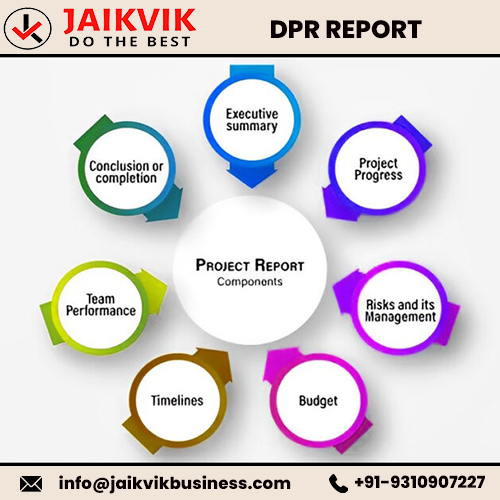
It usually contains:
Executive Summary
Business Description
Market Analysis
Product or Service
Operational Plan
Marketing and Sales Strategy
Financial Projections
Risk Analysis
Funding Requirements
This document aids in the validation of the technical implementation of the project and convinces the concerned stakeholders to believe that the business is viable.
Why Does the Detailed Project Report for Startup?
Drawing up a well-structured Detailed Project Report for Startup is desirable for the following reasons:
Investor Confidence: The DPR will assure potential investors that you have done your research correctly.
Loan Approvals: Before granting any loan, financial institutions require viewing the DPR.
Strategic Planning: Upholds founders in staying focused and making logical decisions.
Government Schemes: Submission of DPR is also sought by many government subsidies and schemes available for startups.
Right in the end, it facilitates decision-making and builds a solid platform for future growth.
Constitutions of DPR for Startup
For proper functioning, a Detailed Project Report for Startup must contain certain sections as an overview in terms of the business. These are critical aspects:
a. Executive Summary
Here lies your first impression; it should highlight your mission, vision, and the summary of your plan.
b. Business Profile
Describe the startup's legal constitution, objectives, and, finally, the background of the founders.
c. Market Research
Conduct a thorough research of all aspects of market needs, competitors, and demand.
d. Technical & Operational Plan
Explain the technology, equipment, human resources, and logistics needed for the delivery of your product or services.
e. Marketing Strategy
Explain your marketing plan to attract, engage and retain customers.
f. Financial Plan
Put forward income statements, projections, balance sheets, and cash flow statements prepared for at least three to five years.
Each of these plays an integral part in displaying your business professionalism and readiness.
How to Design the Most Efficient Detailed Project Report for Startup
A Detailed Project Report for Startup that is precise and convincing follows a few core steps which are:
Identify Business Goals and Audience
You must keep in mind when drafting your DPR whether it is for your use or for possible investors or banks.
Market and Technical Research
Facts, figures, and trends that support the viability of your business ought to be included.
Professional Styling
Use a defined template, appropriate jargon, and avoid ambiguity.
Seek Expert Assistance
An experienced firm such as Jaikvik Business will bring credibility, compliance, and accuracy. They specialize in customized DPRs prepared for startup requirements.
Review and Revise
Ensure consistency, clarity, and accuracy in all sections.
If a DPR is very well drafted, it can be a make or break point in getting approval from investors and lenders.
Benefits of Getting a Professional Detailed Project Report for Startup
There are a lot of benefits associated with having a Detailed Project Report for Startup drafted by professionals:
Customized Approach: Experts can tailor the DPR as per your industry, business model, and goals.
Credibility Boost: A professional report will reflect on how serious you are concerning the matter.
Error-Free Projections: You'll be able to avoid typical errors regarding estimations in financials and forecasting.
Compliance: Make sure that your DPR falls in line with the regulations of banks and government agencies.
Time-Saving: These professionals deal with the nitty-gritty work of technical writing so you can hog the spotlight on planning the business.
By associating with a recognized company such as Jaikvik Business, you can confidently put your best foot forward in securing funding and ascend quickly.
Industries That Benefit from a DPR for Startup
A Detailed Project Report for Startup benefits various sectors across the world: that is for both software-based and manufacturing units. Here are some sectors where it holds the utmost relevance:
Food & Beverage Startups – For FSSI licensing and bank loans
Healthcare Startups – For regulatory approval and investor pitch decks
E-commerce Ventures – To justify logistics, marketing, and tech expenditure
Agritech Startups – To apply for government funding
Manufacturing Units – For machinery loans and land acquisition
Education Platforms – To attract edtech investment
Whatever sector your startup belongs to, a DPR sets out clear goals, organized funding requirements, and realistic projections.
Conclusion: Choose the Best for Startup Success
The Detailed Project Report for Startup is not merely a formality. It is a strategic road map that may make those who sit down on the roadway or break them. It offers transparency, structure, and financial insights to its stakeholders as well as to the promoters themselves.
For the good of your business, your first choice for association should be experienced people like Jaikvik Business, who specialize in developing DPRs with a determinable fit to industry and funding requirements. A universal and comprehensive DPR would take your startup from the brink of expression to well on the way to success, whether in front of an investor or a government grant.
Key Highlights: Detailed Project Report for Startup
Frequently Asked Questions
1. What happens when a Detailed Project Report is prepared for a startup?
A Detailed Project Report for a startup is a systematic document highlighting the business idea, market potential, financials, operations plan, and expected results. It is helpful for attracting funding and mapping out the growth plan of the startup.
2. Why does a Detailed Project Report hold relevance for startups?
A DPR lets investors, banks, and government schemes decide whether the business is worth it, but it is also the means to back up the startup by research, planning, and identified financials, so the success and funding stand a better chance of being attained.
3. Who creates the best Detailed Project Report for startups?
Jaikvik Business, an expert business consultancy, designs detailed and customized DPRs for startups in various sectors to make sure all regulatory, financial, and strategic factors are included.
4. What are the components of a DPR for startups?
The startup DPR will include the executive summary, company profile, market analysis, product/service, marketing strategy, financial projection, funding requirements, risk analysis, and implementation plan.
5. Is the Detailed Project Report necessary for obtaining startup loans or funding?
Yes, almost all banks, NBFCs, and investors insist on conducting due diligence on the project's viability through a well-executed DPR before permits and approval for granting loans or investment. A DPR developed by Jaikvik Business gives a lot of weight to the consideration for approval.